

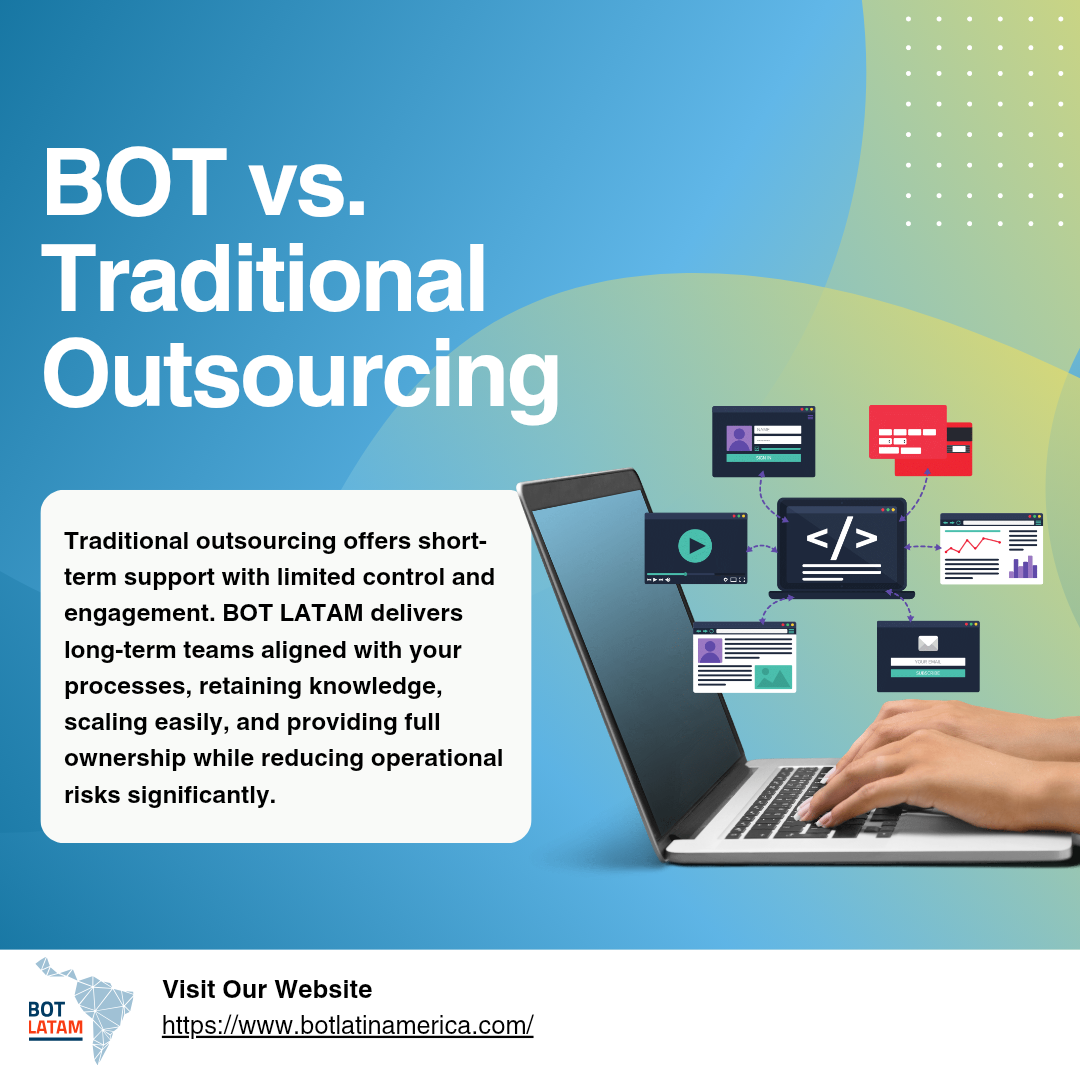
Software engineering BOT models are becoming widely adopted because companies today need a smarter and more controlled way to scale their development efforts without making heavy long-term commitments from day one. As product roadmaps grow more complex and competition in digital markets intensifies, businesses can no longer rely solely on short-term outsourcing or rushed in-house hiring. BOT models offer a structured path that allows organizations to build dedicated engineering teams that are fully aligned with their technical standards, workflows, and business goals from the very beginning. What makes this model especially relevant now is the balance it creates between flexibility and ownership. During the build and operate phases, companies benefit from local expertise, established processes, and reduced operational risk, while still maintaining visibility and influence over how teams are formed and managed. Once the team reaches maturity, the transfer phase enables a smooth transition to full ownership, eliminating disruption and preserving team continuity. In an environment where scalability, retention, and long-term value matter more than short-term savings, BOT models in LATAM have naturally become a preferred approach for sustainable software engineering growth.
Why LATAM Is the Ideal Region for Software Engineering BOT Models in 2026
Unmatched Time Zone Alignment for Real-Time Engineering Execution.
One of the most decisive factors driving BOT adoption in Latin America is time zone alignment with North American markets. In 2026, software delivery depends heavily on speed, iteration, and constant feedback. LATAM teams operate within close working hours to US product owners, architects, and engineering leaders, which removes the delays commonly caused by offshore collaboration. This enables real-time sprint planning, live technical discussions, immediate issue resolution, and faster approval cycles. For BOT models specifically, this alignment is critical during the operating phase, when teams must function as an extension of the internal engineering organization. Daily collaboration builds shared context, reduces misunderstandings, and allows teams to move with the same urgency as in-house developers. Over time, this creates a natural transition toward ownership, where the BOT team already operates as part of the core business rather than a remote dependency.
Enterprise-Grade Communication and Cultural Compatibility.
LATAM has become a preferred region for BOT models because communication quality has reached an enterprise level. Engineering teams across the region are accustomed to working with US and global brands, following agile frameworks, participating in product-driven conversations, and contributing beyond task execution. English proficiency continues to improve, but more importantly, teams understand how to communicate clearly, raise risks early, and collaborate across roles. Cultural compatibility plays a major role here. LATAM engineers are comfortable with accountability, structured feedback, and iterative improvement. They align well with product-focused development environments where engineers are expected to challenge ideas, propose alternatives, and think long term. This cultural fit reduces friction during onboarding and makes it easier for BOT teams to adopt internal standards, values, and engineering practices from the very beginning.
Talent Depth Designed for Complex, Long-Term Products.
By 2026, LATAM is no longer positioned as an emerging talent market. It is a mature engineering region with strong depth across backend, frontend, cloud, DevOps, data, and AI-driven development. What makes this especially relevant for BOT models is the ability to hire engineers who can own systems over time, not just contribute to short delivery cycles. BOT structures require teams that can handle evolving architectures, scale platforms, maintain legacy systems, and support continuous improvement. LATAM engineers increasingly bring experience from long-running products, regulated industries, and high-growth digital platforms. This allows companies to build teams that are technically capable from day one and remain valuable well after the transfer phase, supporting product stability and innovation simultaneously.
Cost Structures That Support Strategic BOT Investment.
Cost efficiency remains an important consideration, but in 2026, the value LATAM offers goes beyond lower rates. BOT models require upfront investment in team design, leadership, documentation, and process maturity. LATAM’s cost structure allows companies to make these investments without compromising financial sustainability. Instead of optimizing purely for short-term savings, organizations can focus on building balanced teams with senior engineers, technical leads, and delivery managers. This results in stronger engineering foundations, better retention, and fewer disruptions during transfer. The outcome is a BOT team that feels like a true internal department, not a cost-driven external unit that needs constant oversight.
Proximity That Strengthens Trust and Operational Control.
Geographic proximity continues to matter, especially for BOT models that emphasize ownership and long-term integration. LATAM’s closeness to North America makes in-person collaboration realistic when needed. Leadership visits, onboarding workshops, architecture sessions, and strategic planning meetings can happen without excessive travel time or cost.
This proximity helps strengthen trust between stakeholders and engineering teams. It also allows companies to maintain a higher level of operational visibility throughout the BOT lifecycle. When teams are easier to access, both physically and operationally, companies feel more confident investing in long-term structures and committing to the eventual transfer of ownership.
Leadership Availability That Supports BOT Governance.
A successful BOT model depends on strong local leadership during the build and operate phases. LATAM offers a growing pool of engineering managers, technical leads, and delivery leaders who understand both regional talent dynamics and global enterprise expectations. This leadership layer ensures that teams are not just staffed quickly, but structured correctly. Local leaders help enforce coding standards, performance metrics, security practices, and documentation requirements. They also act as a bridge between the client organization and the engineering team, ensuring alignment at both strategic and operational levels. As the BOT matures, this leadership plays a critical role in preparing the team for transfer, making sure ownership can shift without disrupting delivery or morale.
Ecosystems That Encourage Innovation and Skill Growth.
LATAM’s technology ecosystems have matured significantly, with active developer communities, startup hubs, and cross-border collaboration becoming the norm. Engineers are exposed to modern tools, evolving frameworks, and real-world scalability challenges. This environment supports continuous learning, which is essential for BOT teams expected to grow alongside the product. For companies building long-term engineering units, this means access to teams that are not static. LATAM engineers actively adapt to new technologies, refine best practices, and contribute ideas that improve product quality and development efficiency. This innovation mindset aligns well with BOT models that prioritize sustainability and long-term value creation.
Legal and Operational Readiness for BOT Transitions.
In 2026, BOT success is closely tied to operational clarity and compliance readiness. LATAM countries have gained significant experience supporting international engineering operations, including structured employment models, IP protection practices, and cross-border collaboration frameworks. This operational maturity makes it easier to structure BOT agreements that support a clean and predictable transfer phase.
Clear processes around contracts, data handling, and team ownership reduce uncertainty and risk. Companies can focus on building and operating high-performing engineering teams without being distracted by regulatory ambiguity. When the time comes to transfer ownership, the groundwork has already been laid for a smooth and controlled transition.
A Region Aligned With the Future of BOT Models.
LATAM stands out in 2026 because it aligns naturally with what BOT models are designed to achieve. It supports real-time collaboration, long-term team stability, technical ownership, and operational confidence. Rather than functioning as a temporary solution, LATAM enables companies to build engineering teams that evolve into core business assets. As more organizations move away from transactional outsourcing and toward ownership-driven global expansion, LATAM continues to prove itself as the ideal environment for BOT models. The region offers the right balance of talent, structure, and scalability needed to build, operate, and ultimately transfer software engineering teams with confidence.
Why BOT Latam Makes Your Software Engineering Vision Reality
BOT Latam builds engineering teams that feel like they’ve always been part of your company. Every BOT model we manage is crafted to grow with your product, operate like an internal unit from day one, and eventually transfer smoothly into your ownership without losing momentum. Our LATAM-based teams combine technical mastery, cultural alignment, and real-time collaboration to deliver code, ideas, and innovation as if they were sitting across the table from you. We believe BOT is a strategic advantage. With BOT Latam, your team isn’t temporary; it’s a foundation for long-term growth, built to evolve alongside your business. Reach out to us today and see how we can turn your software engineering ambitions into reality. We will answer your initial queries on a complimentary strategy call!

Revolutionize Your Workflow with Our Innovative BOT Strategy!
Enhance your operations seamlessly and adapt to market demands
Contact Us


.jpg)