
The Build Operate Transfer nearshore model is now considered as the premier strategy for U.S. tech firms seeking more than just "rented" talent. While the "Build" and "Operate" stages focus on recruitment, cultural alignment, and operational excellence, the BOT model transfer phase is the ultimate destination. This is the moment where a vendor-managed team becomes a core corporate asset. As we move deeper into 2026, BOT models are a strategic necessity for long-term scalability and intellectual property security. The following article deconstructs the mechanics of the Transfer phase, outlining the legal, operational, and cultural shifts required to bring your LATAM engineering hub home.
Defining the 'Transfer' in 2026
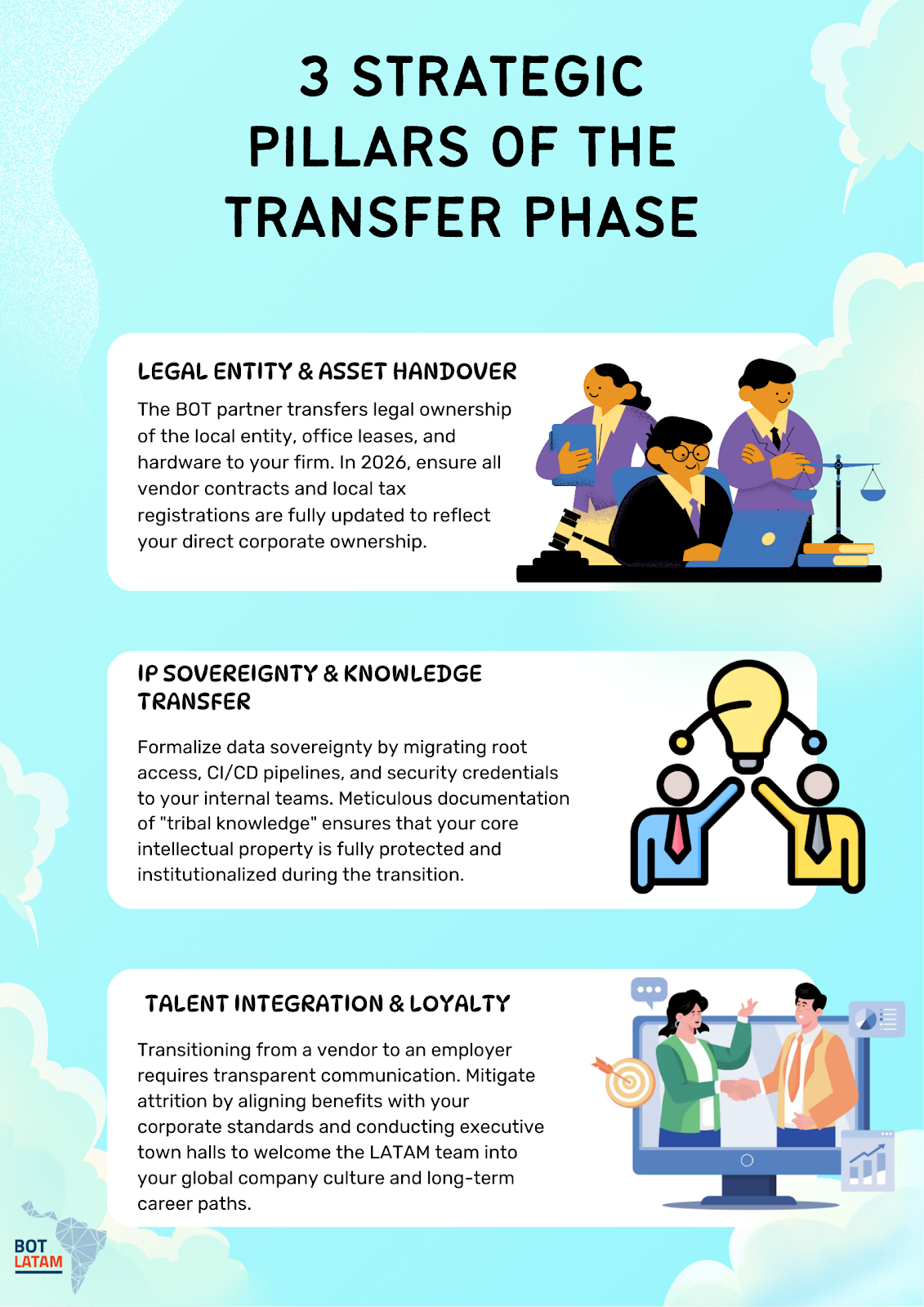
The Transfer phase is the point in a BOT contract, typically occurring between month 12 and month 36, where the legal ownership of the team, the local entity, and all associated infrastructure moves from the BOT partner to the client. This is the "T" in BOT, and it is what separates this model from traditional staff augmentation or simple outsourcing. Unlike traditional staff augmentation, where the partnership ends with the off-boarding of contractors, the BOT model transfer phase is a "re-boarding." It is the institutionalization of a team that is already high-performing, culturally synced, and deeply familiar with your product roadmap. In 2026, the focus is on de-risking the transition by ensuring that the team doesn't just work for you, but is effective for you.
Why Transfer Matters for Valuation
For tech firms looking toward an exit or an IPO, owning your engineering team is a massive valuation multiplier. Investors in 2026 are increasingly wary of companies that rely solely on third-party agencies for their core IP. The Transfer phase converts a monthly service fee into a tangible offshore subsidiary. This shift from a vendor relationship to an owned asset changes the company's balance sheet, moving software development costs from a pure expense to an investment in the company’s structural capital.
The Operational Handover
The BOT model transfer phase is often misunderstood as a simple payroll update. In reality, it involves a complex handover of the "Operational Blueprint" that has sustained the team during the Operate phase. It requires a careful audit of everything that makes the office run, from the physical chairs to the digital security protocols.
Infrastructure and Facility Management:
If your BOT partner has established a physical office or "Center of Excellence" in a hub like Medellín, Mexico City, or Buenos Aires, the transfer includes the assignment of leases, security protocols, and hardware assets.
- Asset Audits: You must ensure all hardware and software licenses are accounted for and transferred to the new local entity.
- Vendor Contracts: This involves handing over relationships with local internet service providers, cleaning staff, and office management.
- Security Logistics: Transferring physical access controls, surveillance systems, and biometric data management to your internal security team.
Compliance and HR Frameworks:
Latin American labor laws are famously intricate and vary significantly between jurisdictions like Brazil, Colombia, and Mexico. During the Transfer, the client must be prepared to manage:
- Employment Contracts: Transitioning developers from the BOT partner’s payroll to the client’s local legal entity requires new contracts that comply with local labor codes while maintaining the spirit of the original agreement.
- Benefits Parity: It is vital to ensure the benefits package remains consistent. This includes local requirements like Aguinaldo (13th-month salary), specific health insurance tiers, and statutory vacation time to prevent talent attrition.
- Payroll Continuity: Establishing a bridge so that there is zero lag in payment during the month the entity changes.
Intellectual Property and Data Sovereignty
In the Build Operate Transfer nearshore model, IP is generated by the team for the client from day one. However, the Transfer phase formalizes "Data Sovereignty," which is the total control over the environments where that IP lives and the legal framework that protects it.
Secure Knowledge Transfer:
The goal is to ensure that no "tribal knowledge" remains with the BOT partner. This involves a rigorous documentation process that should ideally begin months before the actual transfer date.
- System Admin Privileges: Handing over root access to all cloud environments, CI/CD pipelines, and internal databases.
- Standard Operating Procedures (SOPs): Detailed documentation of the specific workflows, deployment schedules, and QA processes that were refined during the "Operate" phase.
- Security Credentials: Rotating all keys and passwords to ensure that the BOT partner no longer has backend access to sensitive client data.
Legal Cleanliness and IP Assignment:
A rigorous legal audit is conducted to ensure that the BOT partner has no lingering claims on the works created.
- IP Chain of Title: Verifying that every developer has signed the necessary IP assignment clauses that link back to the parent company.
- Warranty of Non-Infringement: Obtaining legal guarantees from the BOT partner that the team has operated within the bounds of all software licenses and third-party IP agreements.
- Clean Bill of Health: This is essential for U.S.-based legal departments to sign off on the acquisition of the local team, ensuring there are no hidden liabilities.
Managing the "New Employee" Experience
Perhaps the most critical and overlooked aspect of BOT model transfer phase is the psychological transition for the developers. Even if they have worked with your U.S. team for two years, the day they become "official" employees of your company is a major milestone.
Maintaining Culture and Loyalty:
One of the primary risks during Transfer is "Employee Anxiety." Developers may wonder if their benefits will change or if the U.S. headquarters will treat them differently than the local BOT partner did.
- Executive Town Halls: Direct communication from U.S. leadership explaining the vision for the local hub and reinforcing their value to the global organization.
- Welcome Kits and Onboarding: Treating the transfer as a "Day One" experience, complete with company-branded gear and a formal welcome into the corporate culture.
- Career Pathing: Showing the LATAM team that they now have the same growth opportunities, stock options, and long-term career trajectories as their U.S. counterparts.
Integration with Global Teams:
During the Operate phase, the BOT partner often acts as a buffer for administrative and cultural issues. In the Transfer phase, that buffer disappears.
- Unified HR Systems: The LATAM team must be fully integrated into global HRIS systems, performance review cycles, and feedback loops.
- Managerial Training: U.S. managers may need specific training on how to manage direct international employees, as opposed to managing a vendor relationship.
- Communication Channels: Moving the team from the partner’s Slack or Microsoft Teams environment into the client’s internal workspace without losing historical data.
The Financial Transition: From Service Fee to Subsidiary
From a CFO's perspective, the Transfer phase is where the "arbitrage" of nearshoring matures into "operational efficiency." It is the moment where the "cost-plus" model of the BOT partner is replaced by the actual cost of running a subsidiary.
Eliminating Management Fees:
The primary financial benefit of the Transfer is the elimination of the BOT partner's management markup. Once the team is transferred, the client pays only the direct costs of salaries, taxes, and office overhead. This usually results in a 15 to 25 percent reduction in the total cost of the team overnight.
Setting Up the Local Entity:
While the BOT partner manages the team initially, the client typically needs to establish their own local legal entity to receive the transfer.
- Legal Incorporation: Establishing a local branch such as an SAS in Colombia, a S.A. de C.V. in Mexico, or an Ltda in Brazil.
- Tax Planning: Understanding the tax implications of owning a foreign subsidiary, including transfer pricing regulations and local corporate income taxes.
- Banking and Finance: Setting up local bank accounts and capital injection processes to fund the subsidiary's operations.
Avoiding the Common Pitfalls of the Transfer Phase
Even the most successful BOT partnerships can stumble at the finish line if the Transfer is rushed or viewed as a purely administrative task.
The "Silent" Attrition Risk:
If the transition isn't handled with transparency, top-tier developers might view the change in ownership as a moment of instability and look for other opportunities. In the highly competitive LATAM tech market of 2026, "headhunters" often target teams during a transfer. Engagement must be at an all-time high during the 90 days leading up to the Transfer.
Underestimating Local Compliance:
U.S. firms often assume that "ownership" is simple because they already know the team. However, the legal requirements of becoming an employer of record in a country like Argentina or Chile are stringent.
- Expert Counsel: Partnering with local legal counsel or a specialized PEO (Professional Employer Organization) to act as a bridge during the first six months of ownership is often the safest path.
- Regulatory Reporting: Ensuring the new entity is registered with all necessary social security and tax authorities to avoid immediate fines.
Why We’re Trusted to Get the Transfer Right
BOT LATAM doesn't see the BOT partnership handover phase as the end of a partnership. We see it as the moment everything we’ve built together proves its value. From the very first hiring decision to the final legal handover, our entire BOT framework is designed with one clear outcome in mind: a clean, confident, and fully de-risked transfer of ownership to you. We operate with transfer-readiness built into every process, such as documentation, IP assignment, compliance, cultural alignment, and leadership continuity are never afterthoughts for us. By the time the Transfer phase begins, your team is already functioning as your organization in every way that matters. Contact us to learn how BOT LATAM can help you design, operate, and seamlessly transfer your nearshore team with confidence and zero surprises. We also offer a complimentary strategy call!

Revolutionize Your Workflow with Our Innovative BOT Strategy!
Enhance your operations seamlessly and adapt to market demands
Contact Us